Monday, January 11, 2010

French Onion Soup a la rice cooker

Pray tell, what could be easier…
PB170125
…first brown 3 onions in the Cook Japan rice cooker using the “braise function” (or do it in a pan if your machine does not have this option…
PB150112
…then add 4-cups of water into which you’ve dissolved 2tbsp of beef bouillon, a dash of Worcestershire sauce and a bit of salt…
PB150113
…set the “slow cook” function for around 3hours and come back to it later, when its had chance to sit a little longer on “keep warm” to intensify the flavour and voila…
PB170115
…top it off with a piece of cheesy toast and its a supremely easy way to cook a lovely heart-warming soup…
PB170125
For more information visit: www.cookjapan.co.uk

Thursday, January 7, 2010

Nanakusa-gayu (Seven herb porridge)

Eaten and drunk too much over the past couple of weeks?  Feeling a bit lardy, lethargic and lumpy?  Have a bowl of Nanakusa-gayu (seven herb porridge)…

727px-Nanakusa_gayu_on_Nanakusa_no_sekku

After indulging too much over ohshogatsu (new year), a long standing tradition in Japan is to eat nanakusa-gayu on 7th January.  Not only is it a simple low-calorie food after all that richness over the previous few days, but importantly it is believed to bring longevity and health, and also intended to ward off evil for the coming year.

The tricky bit if you’re not in Japan (where you can actually special packs at this time of year in the supermarket) is how to get the 7 herbs, traditionally (but with local variations):

  • seri – Japanese parsley
  • nazuna – Shepherd’s purse
  • gogyo – Jersey Cudweed
  • hakobera – Common chickweed
  • hotokenoza – nipplewort
  • suzuna – turnip
  • suzushiro - daikon

200px-The_seven_herbs

Your best bet is to therefore replace these greens with whatever locally available green leaf vegetables you can easily get hold of, and more importantly like.  So, armed with some lovely fresh greens how do you make this porridge?

Well, first things first, its not porridge in the western rolled oats sense of the world, this is an Asian rice porridge (in Japan referred to as okayu – but not much different from what you would find in China as congee or similar dishes elsewhere throughout SE Asia). 

In a rice cooker its an absolute breeze to make…

…wash the rice thoroughly, then put 1 cup of rice into the rice cooker with 7 cups of water, press “Congee” and leave the rice to cook.  Probably takes about 40-minutes or so and then it will have a nice porridge consistency (see top photo).  At this point ,add your chopped greens and leave it on “Keep Warm” for a few minutes – but not too long as you don’t want everything to wilt too much.  Add a little bit of salt and serve…how easy is that!

Saturday, January 2, 2010

Sardines with Mentaiko

What is mentaiko I hear you ask? Well, its marinated Pollock roe to the unitiated…

PB080075

…but this isn’t any mentaiko, its karashi mentaiko or spicy fish eggs!

In case you’re not sure, the mentaiko is the orangey/brown balls on the outside of the fish.   Of course the bowl of rice was courtesy of the dear old Cook Japan rice cooker, but what a wonderful combination for a quick easy healthy lunch…

PB080065

The sardines have been cooked have a sweet soy sauce taste from their own marinade, which combined with the slightly spicy marinated mentaiko is a great fusion of flavour and texture.  With a steaming bowl of fresh rice its a real treat along with a piping hot bowl of miso soup and a side of homemade gobo (burdock) salad…

PB080077

Osechi Ryori Part 2

Come on, you didn’t really expect me to allow the leftovers to go to waste did you?

PB080054

A great end to the first day of the year!

Friday, January 1, 2010

Osechi ryōri (Japanese New Year Meal)

あけましておめでとうございます! Happy New Year!

1st of January can mean only one thing in many Japanese households – osechi.  Osechi ryori is the traditional Japanese food eaten on New Years Day dating back centuries, an array of delicate dishes presented in lacquered boxes.  This year we didn’t get back to Japan so made it at home (check the bottom of the post for last years photos from Japan).

In addition to the traditional 3 jubako (lacquer boxes) we indulged in some homemade sushi and got some chu-toro (tuna belly) for sashimi…

PB070037PB070032

…while not quite up to the standards of a master in Japan, this was really nice sushi (squid, octopus, prawn and saltwater eel)…

PB070047

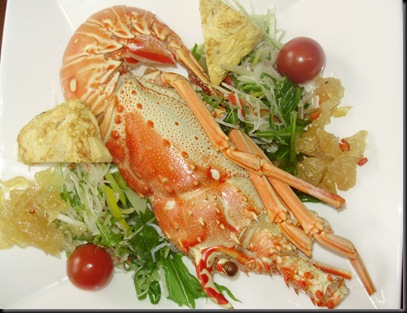
The jubako roughly followed the Japanese traditional one one being seafood, one from the land and one from the earth...

PB070038 PB070039 PB070040 

I couldn’t resist this little photo of one of the Cook Japan kids fave osechi dishes – ebi prawn) tempura on one of our “only to be used on New Years Day plates”…

PB070051

Osechi wou;dn’t be osechi though without also having a bowl of ozoni – soup with “mochi” (steamed rice pounded into a sticky/elasticy rice cake) inside…but its not for the faint hearted!  Each year there are a few small deaths recorded from people choking on mochi!"
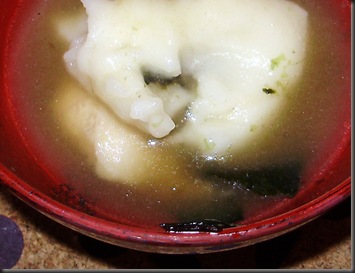
PB070050

So that was our attempt at making osechi and it was a wonderful meal and perfect way to start what will hopefully be a good 2010.  Last year, we were back in Japan and this is the magnificent food Mrs Cook Japan’s mum rustled up…a true master of the kitchen!!!
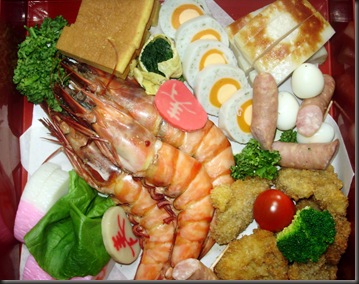
PB270265

PB270266

PB270268PB270267

…and yes, it did taste as amazing as it looked!

PB270271

So with the osechi devoured, there’s only one thing left for me to do…relax and enjoy hatsuburo (the first bath of the year).  Oh, and the kids will be expecting otoshidama – the traditional Japanese gift of money on New Years Day!

Happy New Year everyone…and don’t forget the Cook Japan shop is running a 10% discount on all stock through January.

Osechi on Foodista

Wednesday, December 16, 2009

Eintopf (German one pot stew)

Following a chat about food with two German chums, Helge and Lasse, we thought we should try making Eintopf  in the Cook Japan rice cooker:
CIMG1581
For those new to this dish, that includes Cook Japan until 48-hours ago, Eintopf means literally “one pot” and is a traditional type of German stew which can consist of a great number of different ingredients. Technically, the term refers to a way of cooking all ingredients in one pot, not to any specific recipe.
Not knowing quite where to start we therefore followed Lasse’s lead and opted for the following recipe which we cooked with the “soup” mode (plus a bit of braising)…
…first up braise some bacon and German sausage in the rice cooker, once browned put this to one side, switch to “soup” and get on with the liquid component of dinner.  In this case, we used peas, leeks, carrots, celery, potatoes, bay leaf, onion, some bouillon and seasoning.  Once the soup was underway, the sausages and bacon were re-added to the rice cooker and left to cook…
CIMG1580
Once cooked the dish sits quite happily on “keep warm” intensifying flavours until ready to be devoured by very cold hordes at dinner time…and the best thing is there just enough for a very small cold horder to eat some more tomorrow!
CIMG1581v2
As with many great dishes this is Eintopf is about using ingredients to hand rather than rigidly sticking to a recipe, this was our first experiment and according to our German friends not a bad start either.
For more information visit: www.cookjapan.co.uk

Tuesday, December 1, 2009

Slow Cooked Pork (in the Rice Cooker)

This is a slight variation of a firm Cook Japan family favourite…buta no kakuni (Japanese braised pork belly).  Mrs Cook Japan is loving our local supermarket’s so called “forgotten cuts”, in this case pork cheeks… 

PA060033

…so it was still pork, just that it happened to be cheeks and not belly…I have to say if you are a fan of slow cooking pork cheeks are a wonderful cut of meat for this type of dish with a fabulous texture.

So the recipe…Mrs Cook Japan’s secret  is to cook the meat in earl grey tea for 1-1.5 hours until it is really tender, she then changes this to fresh water and adds ginger, garlic,dried lily flowers and daikon (long white Japanese radish) along with soya sauce, mirin, sake and sugar which gives the dish its lovely sweet syrupiness.  The whole thing is put in the rice cooker and left to cook for a couple of hours, after which a few spring onions and leeks go in and everything is left on “keep warm” until its time to eat.

PA050231

One of the great things about this dish is the way the daikon soaks up the sauce, creating this wonderful marbling effect and making it absolutely delicious…

PA050233

The finished pork just falls apart on your fork/chopsticks, the tenderness of the meat and flavour is superb and only increases with time (especially if there’s some left for the following day). 

PA060029

Served on a bed of rice (thankfully we have 2 rice cookers for when it comes to making meals like this), the only drawback was having friends pop round…once they’d had a bowl as well it meant was nothing left for me reheat tomorrow…