Showing posts with label japanese recipes. Show all posts

Sunday, February 21, 2010

Cooking Nabe on an Induction Hot Plate

A portable induction hot plate is a great addition to any kitchen. They are perfect for cooking a variety of Japanese nabe (one pot) dishes, where family and friends sit around the nabe, eating, cooking, talking and having fun.

In Japanese cooking the nabe pot is usually placed in the centre of the tables and shared by family and friends, not only is this considered a very sociable way to eat, but is the reason for the saying Nabe o kakomu (鍋を囲む"sitting around the pot"), implying that sharing nabe will create warm relations between the diners who eat together from the shared pot.

Nabe is a wonderful meal, especially in these cold winter months.  Induction heating technology means that cooking with an induction hob is not only energy efficient, but time saving as well with up to 90% more efficiency, 50% energy savings and 30% faster cooking times.

For more information visit: www.cookjapan.co.uk

Sunday, February 14, 2010

Rice Cooker Ikameshi (Squid stuffed with rice)

For squid fans out there – why not try ikameshi (squid stuffed with glutinous rice)
PC210304
Its incredibly easy to do in the rice cooker, first up take a large squid and stuff it with glutinous rice (not to full, as the rice will expand), and we also added a few chopped up bits and pieces of squid, then close the end using a toothpick and pop them in the rice cooker…
             PC210267 PC210272
…along with sake, mirin, sugar and a pinch of salt and a little bit of soy sauce. We also put a piece of baking parchment over everything then popped it into the rice cooker for 30-minutes… 
PC210292
…plate up with the sauce that its been cooked in, you’ll probably find a fair bit of rice has eked out into the liquid but that’s fine and garnish with some spring onion and a bit of grated ginger…
PC210294
…or just slice it open on a plate and devour it…

For more information visit: www.cookjapan.co.ukPC210282

Wednesday, February 10, 2010

Sausage and Chestnut Rice

PB250183
One of the joys of cooking in a rice cooker is the ease with which you can literally “dump” ingredients into the machine and come back later to a delicious meal.  This time in went shiitake mushrooms, chestnuts and some “sausage-meat-balls”, along with a dash of soy sauce…
PB250166
Admittedly making meatballs isn’t too difficult or time consuming, but why not just take some sausages, remove the casing, mix with soy sauce and a bit of seasoning then make into bite size meatballs?  If you are lucky enough to be able to get fresh chestnuts then use those, but equally easy is just using canned chestnuts…
PB250184   …delicious, simple and a joy to eat.
For more information visit: www.cookjapan.co.uk

Friday, January 15, 2010

Making Mochi

I have to put my hands up and admit I’m not a big fan of mochi (rice cake made of glutinous rice pounded into paste and molded), but it is a mainstay of Japanese cuisine and served in soup (ozoni) is a traditional aspect of New Year…
PB200158
So without entering into the mochitsuki ceremony how did we make mochi? (Well, when I say “we”, I mean Mrs Cook Japan and the 10 friends and countless children who had a great time making and eating it at our house.)
First up, mochigome (special glutinous rice for making mochi) was left to soak then wrapped in muslin and steamed in the Cook Japan rice cooker…
         PB200145PB200152
…and this is where the brilliant idea came into play…use a breadmaker!!!
Traditionally the rice is steamed then put into a huge mortar where it is a pounded to make a paste, whereas their plan was to put the rice into a breadmaker using the “dough” function and keep 20+ collective fingers crossed on the results….
…and what great results they were!  About 30-minutes in the breadmaker produced a wonderfully sticky paste that could be easily moulded then devoured…
            PB200148PB200157
And what a feast it turned into, never before have I seen so much mochi in one place.  Eaten with adzuki (red beans), natto (fermented soya beans), daikon oroshi (grated radish), kinako (soybean flour), and of course as ozoni, everyone had a whale of a time.
PB200146PB200151 PB200149    
So if you’ve got a breadmaker to hand, start steaming your rice and start making mochi!

For more information visit: www.cookjapan.co.uk

Thursday, January 14, 2010

Rice, Teriyaki Chicken, Burdock Root and (Eggy) Miso Soup

…yeah you read that right, “Burdock Root” (gobo).  Do you remember drinking dandelion and burdock as a kid, well this is the root it is made from… 

PB170132

We are really lucky because our friend Ikuko-san has a Japanese vegetable farm in Sussex so we can actually get fresh burdock root from her (by their very nature is a root fresh?).  At the top of the picture is kinpira gobo (braised burdock root – the thin one) with renkon (lotus root).  Alongside which is some lovely chunks of chicken in a teriyaki sauce and lightly tempura’ed leeks.

Alongside which was the obligatory bowl of Japanese rice…

PB170138

…and a light miso soup into which a poached egg was inserted – delicious!!  I can heartily recommend this combination for any lovers of miso and egg out there…

PB180142

Thursday, January 7, 2010

Nanakusa-gayu (Seven herb porridge)

Eaten and drunk too much over the past couple of weeks?  Feeling a bit lardy, lethargic and lumpy?  Have a bowl of Nanakusa-gayu (seven herb porridge)…

727px-Nanakusa_gayu_on_Nanakusa_no_sekku

After indulging too much over ohshogatsu (new year), a long standing tradition in Japan is to eat nanakusa-gayu on 7th January.  Not only is it a simple low-calorie food after all that richness over the previous few days, but importantly it is believed to bring longevity and health, and also intended to ward off evil for the coming year.

The tricky bit if you’re not in Japan (where you can actually special packs at this time of year in the supermarket) is how to get the 7 herbs, traditionally (but with local variations):

  • seri – Japanese parsley
  • nazuna – Shepherd’s purse
  • gogyo – Jersey Cudweed
  • hakobera – Common chickweed
  • hotokenoza – nipplewort
  • suzuna – turnip
  • suzushiro - daikon

200px-The_seven_herbs

Your best bet is to therefore replace these greens with whatever locally available green leaf vegetables you can easily get hold of, and more importantly like.  So, armed with some lovely fresh greens how do you make this porridge?

Well, first things first, its not porridge in the western rolled oats sense of the world, this is an Asian rice porridge (in Japan referred to as okayu – but not much different from what you would find in China as congee or similar dishes elsewhere throughout SE Asia). 

In a rice cooker its an absolute breeze to make…

…wash the rice thoroughly, then put 1 cup of rice into the rice cooker with 7 cups of water, press “Congee” and leave the rice to cook.  Probably takes about 40-minutes or so and then it will have a nice porridge consistency (see top photo).  At this point ,add your chopped greens and leave it on “Keep Warm” for a few minutes – but not too long as you don’t want everything to wilt too much.  Add a little bit of salt and serve…how easy is that!

Saturday, January 2, 2010

Sardines with Mentaiko

What is mentaiko I hear you ask? Well, its marinated Pollock roe to the unitiated…

PB080075

…but this isn’t any mentaiko, its karashi mentaiko or spicy fish eggs!

In case you’re not sure, the mentaiko is the orangey/brown balls on the outside of the fish.   Of course the bowl of rice was courtesy of the dear old Cook Japan rice cooker, but what a wonderful combination for a quick easy healthy lunch…

PB080065

The sardines have been cooked have a sweet soy sauce taste from their own marinade, which combined with the slightly spicy marinated mentaiko is a great fusion of flavour and texture.  With a steaming bowl of fresh rice its a real treat along with a piping hot bowl of miso soup and a side of homemade gobo (burdock) salad…

PB080077

Osechi Ryori Part 2

Come on, you didn’t really expect me to allow the leftovers to go to waste did you?

PB080054

A great end to the first day of the year!

Friday, January 1, 2010

Osechi ryōri (Japanese New Year Meal)

あけましておめでとうございます! Happy New Year!

1st of January can mean only one thing in many Japanese households – osechi.  Osechi ryori is the traditional Japanese food eaten on New Years Day dating back centuries, an array of delicate dishes presented in lacquered boxes.  This year we didn’t get back to Japan so made it at home (check the bottom of the post for last years photos from Japan).

In addition to the traditional 3 jubako (lacquer boxes) we indulged in some homemade sushi and got some chu-toro (tuna belly) for sashimi…

PB070037PB070032

…while not quite up to the standards of a master in Japan, this was really nice sushi (squid, octopus, prawn and saltwater eel)…

PB070047

The jubako roughly followed the Japanese traditional one one being seafood, one from the land and one from the earth...

PB070038 PB070039 PB070040 

I couldn’t resist this little photo of one of the Cook Japan kids fave osechi dishes – ebi prawn) tempura on one of our “only to be used on New Years Day plates”…

PB070051

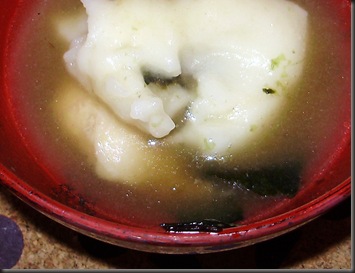
Osechi wou;dn’t be osechi though without also having a bowl of ozoni – soup with “mochi” (steamed rice pounded into a sticky/elasticy rice cake) inside…but its not for the faint hearted!  Each year there are a few small deaths recorded from people choking on mochi!"
PB070050

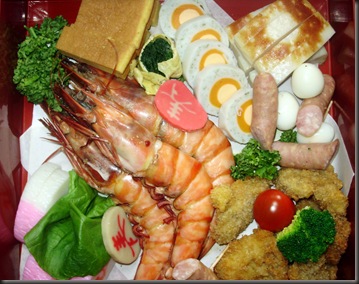
So that was our attempt at making osechi and it was a wonderful meal and perfect way to start what will hopefully be a good 2010.  Last year, we were back in Japan and this is the magnificent food Mrs Cook Japan’s mum rustled up…a true master of the kitchen!!!
PB270265

PB270266

PB270268PB270267

…and yes, it did taste as amazing as it looked!

PB270271

So with the osechi devoured, there’s only one thing left for me to do…relax and enjoy hatsuburo (the first bath of the year).  Oh, and the kids will be expecting otoshidama – the traditional Japanese gift of money on New Years Day!

Happy New Year everyone…and don’t forget the Cook Japan shop is running a 10% discount on all stock through January.

Osechi on Foodista

Tuesday, December 1, 2009

Slow Cooked Pork (in the Rice Cooker)

This is a slight variation of a firm Cook Japan family favourite…buta no kakuni (Japanese braised pork belly).  Mrs Cook Japan is loving our local supermarket’s so called “forgotten cuts”, in this case pork cheeks… 

PA060033

…so it was still pork, just that it happened to be cheeks and not belly…I have to say if you are a fan of slow cooking pork cheeks are a wonderful cut of meat for this type of dish with a fabulous texture.

So the recipe…Mrs Cook Japan’s secret  is to cook the meat in earl grey tea for 1-1.5 hours until it is really tender, she then changes this to fresh water and adds ginger, garlic,dried lily flowers and daikon (long white Japanese radish) along with soya sauce, mirin, sake and sugar which gives the dish its lovely sweet syrupiness.  The whole thing is put in the rice cooker and left to cook for a couple of hours, after which a few spring onions and leeks go in and everything is left on “keep warm” until its time to eat.

PA050231

One of the great things about this dish is the way the daikon soaks up the sauce, creating this wonderful marbling effect and making it absolutely delicious…

PA050233

The finished pork just falls apart on your fork/chopsticks, the tenderness of the meat and flavour is superb and only increases with time (especially if there’s some left for the following day). 

PA060029

Served on a bed of rice (thankfully we have 2 rice cookers for when it comes to making meals like this), the only drawback was having friends pop round…once they’d had a bowl as well it meant was nothing left for me reheat tomorrow…

Saturday, November 21, 2009

Kimchi Nabe

You may already have come across our last night of Nabe action…


…but for those of you who missed out that particular delicacy, nabe is a one-pot Japanese dish consisting of various ingredients which is cooked in (obviously) one –pot in the centre of the table and shared by who ever has the good fortune to be dining with you.

In this case, it was the kids, but once they’d had their fill/got bored of the hassle we pumped up the volume so to speak and chucked in a pile of kimchi (Korean pickled cabbage) and gochujang (fermented chilli sauce) to give it some kick…and a distinctive redder look…

P9210176

Cooked over a camping stove in the middle of the table, this is a wonderful dish as the weather closes in the nights get longer.  In this case, we had the tofu, shiitake mushrooms, prawns, chunks of white fish, dumplings, pork mince balls, udon noodles and a range of Japanese green vegetables we were fortunate to receive today from a friend with a farm specialising in Japanese produce – but you could get away with some Chinese cabbage and rocket.   

P9210169

What makes it yummy is the chilli from the kimchi and gochujang.. definitely a cold-boosting dish and a great meal to share with friends (especially if you have a fridge of cold beers on hand)…

…one of the great things about nabe is that as the pot is kept warm on a portable stove in the middle of the table diners can pick what they want and generally graze.  Eating together from a shared pot is considered as an important feature of nabemono; the belief is that eating from one pot makes for closer relationships. The Japanese thus say, Nabe (w)o kakomu (鍋を囲む、"sitting around the pot"), implying that sharing nabemono will create warm relations between the diners who eat together from the shared pot…
 P9210174
Kimchi on Foodista